






Why do you need a formal Test strategy?
Here are our key "Best Practices" and a guide on how we build a testing strategy for enterprise projects.
1. Shift-Left approach and risk management
The biggest mistake is to start testing only when the code is ready. Our methodology builds on the timely integration of QA into the process.
- Involve QA engineers and automators in the design and requirements analysis phase.
- Why it works: It takes a minimum of time to detect a logical fallacy in architecture on paper. Discovering the same bug after programming costs days of development and hours of rewriting tests. We don't try to test 100% of all possible combinations (exhaustive testing) – instead, we analyze business risks and fully automate the most critical processes.
2. Intelligent Test Layering
Relying only on slow End-to-End (E2E) tests in the browser is inefficient. The strategy must clearly define the levels of testing and their boundaries.
- Unit tests: Extremely fast code-level tests. Best practice: We require a minimum of 80% Code Coverage before approving any changes.
- System and API tests (Core): Validation of integrations and business logic using stateless calls. How-To: Use the AIAO (Almost All In All Out) approach for maximum coverage of background data combinations, without depending on slow UI.
- Communication tests (Smoke checks): Before we run heavy integration tests, we verify open ports, validity of certificates, and availability of third-party systems.
- E2E Integration Tests (Peak): We test critical user journeys from the first click to writing to the database.
3. Data-Driven Testing and Environment Isolation
A test that relies on existing production data is unstable and will fail sooner or later.
- Test Data Management: Test scripts must not contain "hardcoded" data. We apply the Data-Driven Testing approach, where tests dynamically draw or directly generate their own test data (Fixtures) before each run.
- Environment isolation: For massive testing, we don't use one shared environment where the tests block each other. We're rolling out temporary environments in Kubernetes – test containers are dynamically created, test a new feature, and when they're done, the infrastructure destroys itself.
4. Execution in CI/CD and Quality Gates
Automation only makes sense if it is an integral part of the development line. We do not run tests manually.
- Best practice: We integrate tests directly into the CI/CD pipeline (e.g. GitLab CI, Jenkins).
- How-To: Set Hard "Quality Gates". If the automated test detects a high-priority error (Blocker/Critical), the pipeline stops and deployment to production is systemically blocked. The code is returned to the developers for immediate fix.
5. Strict defect management and SLA
The way the team records and resolves errors determines the speed of the entire delivery.
- Defect vs. Change Request: If the system does not work as specified, it is a Defect. If the system works as intended, but the business wants to change the logic, it is a Change Request. We strictly separate these two things.
- How-To: Each bug is prioritized (1 – Showstopper to 5 – Cosmetic). We have clearly defined times for each priority:
- Time to React: How quickly the developer has to accept the bug for resolution (e.g., within 4 hours for priority 1).
- Time to Solve: How quickly the patch must be deployed back to the retest.
6. Transparent Reporting
Testing doesn't end with a green check mark in the console. The outputs must be understandable for technicians and project management.
- Instead of sending static Excel spreadsheets, we link the results from automated tests directly to visualization tools (e.g. Grafana / OpenSearch).
- The result: Management sees clear graphs in real time (Error Trend, Pass/Fail Ratio), while developers have accurate logs and crash logs available at the click of a button for immediate fix.
Conclusion: A successful testing strategy is not about finding all the bugs, but about building a robust process that actively nips bugs in the bud. The right combination of automation, an isolated environment, and well-defined deployment rules is the key to stable and secure software.
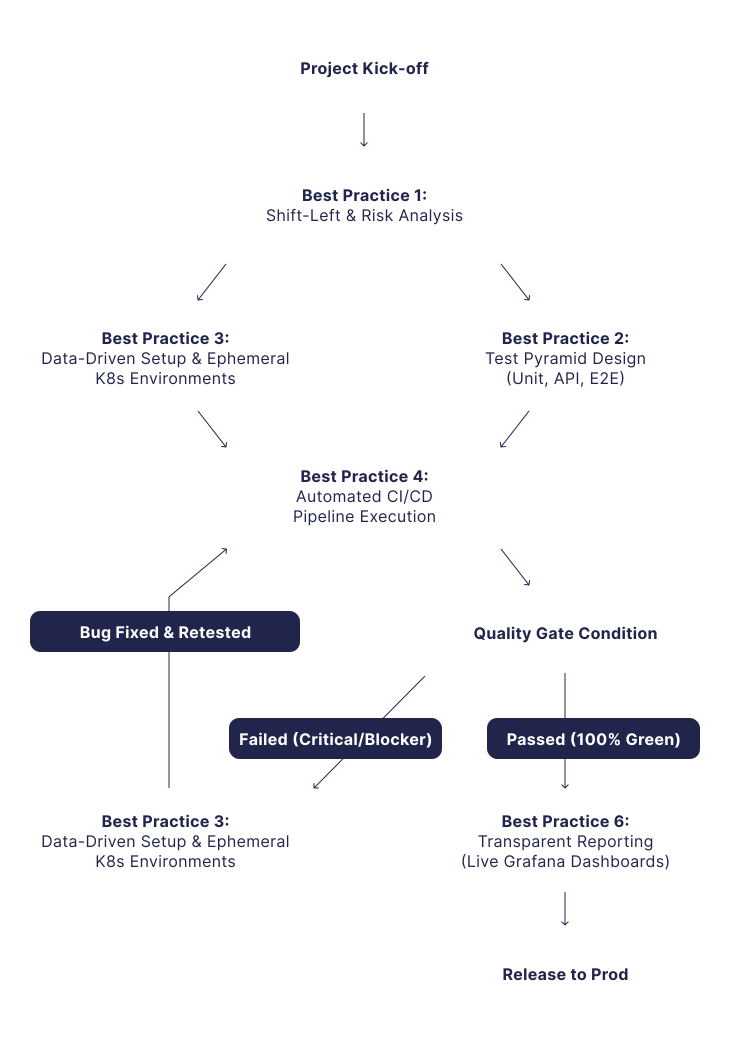
Visual Diagram: Architecture Universal Test Strategy
Below you will find a universal diagram visualizing the basic pillars of a testing strategy across a standard Enterprise project.